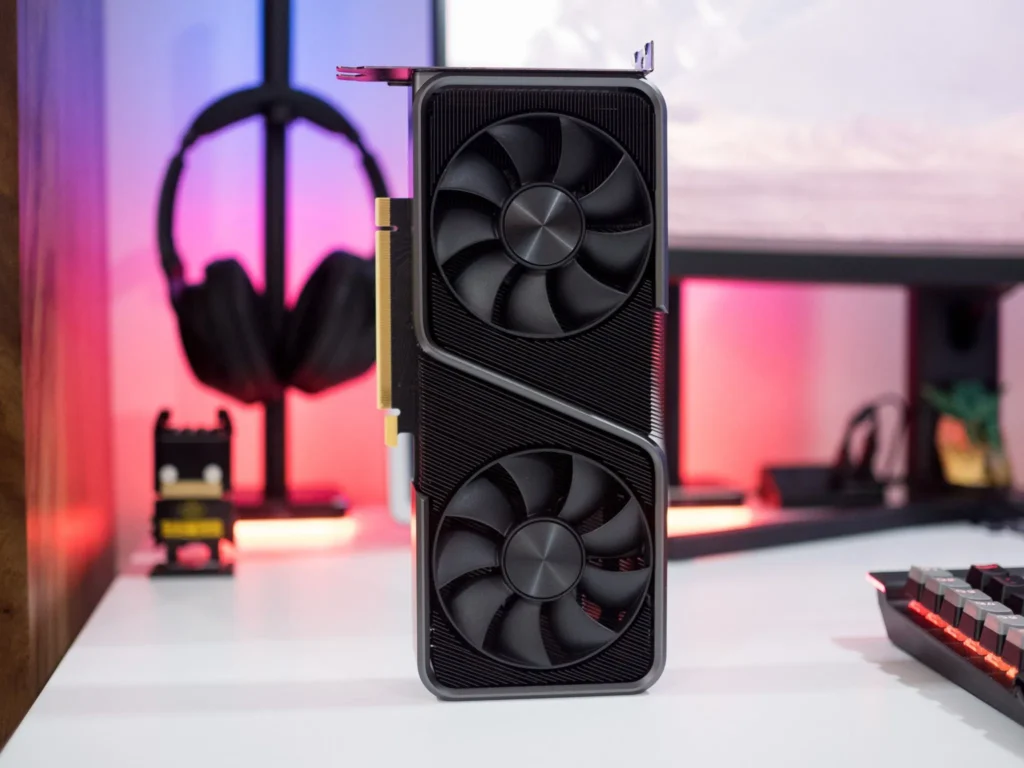
NVIDIA GeForce RTX dual-fan graphics card standing vertically on a desk setup
As of March 2026, the RTX 3070 is one of those “still fast enough” 1440p cards that can be an absolute bargain if you buy it like a sceptic. EU pricing is messy (VAT, shipping, returns), and the used market has a mix of clean gamer cards and tired ex-mining units. Below is a Europe-first fair-price band, two country snapshots, and a quick way to verify temps, stability, and seller honesty before you pay.
Verdict Box(Fair used price (EU): €220–€300)
Buy if:
- You want strong 1440p raster + decent RT for the money (and accept 8GB limits).
- You can verify temps + stability on pickup or within a return window.
- The card is priced near the low end and comes with proof (receipt/serial, clear photos).
Skip if:
- The listing avoids basic questions (“no tests”, “no returns”, “don’t ask”).
- Hotspot / memory temps look suspiciously high under load (or seller refuses to show sensors).
- Price is creeping toward newer-gen alternatives the “new” value case collapses fast.
Fair used price in Europe (2026)
The clean EU anchor is an eBay-based EU tracker showing ~€252 for used RTX 3070 right now, which matches the reality of many EU listings. A practical “don’t overthink it” fair band is €220–€300 if the card is healthy, complete (box/receipt helps), and the seller offers returns or local testing. That band captures common asking prices while leaving room for nicer coolers and remaining warranty.
Country snapshots:
Germany private-market listings commonly sit around €300 VB on Kleinanzeigen, while eBay Germany shows many around €250–€300 depending on model and shipping. In France, browsing LeBonCoin is often more about whole PCs, but it’s still a useful cross-check for local demand and seller behaviour. Marketplaces to watch: eBay (buyer protection/returns vary) and Kleinanzeigen (local pickup leverage).
What affects used pricing
First, returns and proof swing prices more than people admit. A €240 card with a legit return window is often safer than a €210 “no questions” deal. eBay listings frequently show a wide spread because condition notes, shipping, and “tested” claims vary wildly. Second, RTX 3070 has 8GB GDDR6 and a 220W power class, so cooler quality matters: beefy triple-fan AIBs hold clocks better and stay quieter.
Europe also has a big “platform effect”: local pickup (Kleinanzeigen) rewards buyers who can test on the spot, while shipped purchases reward buyers who know how to validate fast. Use the EU tracker as your baseline, then adjust for your exact model and safety factors.
- Condition (dust, corrosion, stripped screws, bent fin stacks)
- Brand/cooler (dual vs triple fan, known noisy fans)
- Warranty/receipt (transferable warranty is a premium)
- LHR vs non-LHR (mostly impacts miner interest, not gaming)
- Marketplace risk (returns, scams, “tested” claims)
- Avoid this: “Works fine” listings with zero photos of ports/PCB + no sensor screenshots.
Is it worth it in 2026?
If you’re shopping used, RTX 3070 still makes sense when the price sits near the EU floor and you’re mainly targeting 1080p/1440p without maxing ultra textures in every new release. NVIDIA positions the 3070 as an Ampere 8GB card (GDDR6) with a 220W class board power, which aligns with solid mid/high-end builds. The problem in 2026 isn’t raw speed it’s 8GB headroom in VRAM-hungry titles and heavy mods.
Who this is for / not for
- For: 1440p esports + most AAA with sensible settings; creators who don’t need huge VRAM.
- Not for: texture-maxing at 1440p/4K, big VRAM workloads, “set-and-forget” future-proofing.
Quick decision: Buy under ~€260 if it’s testable/returnable; hesitate above €300 unless warranty is real.
Best alternatives
The RTX 3070’s closest “EU used logic” alternatives are usually: RTX 3060 Ti (cheaper entry, similar vibe) or RTX 3070 Ti (small uplift, higher power). EU tracker snapshots put used 3060 Ti around €217.71 and used 3070 Ti around €284.52 on eBay-derived pricing, so the decision often becomes “save ~€30–€40” vs “pay ~€30 more”.
AMD’s RX 6700 XT can be attractive on VRAM (12GB), but pricing is inconsistent across sources, so treat any “typical” figure cautiously and verify locally.
| GPU | Typical used price (EU) | VRAM | Best for | Trade-offs |
|---|---|---|---|---|
| RTX 3060 Ti | ~€217.71 | 8GB | Cheapest solid 1440p | Less headroom vs 3070 |
| RTX 3070 | ~€252.09 | 8GB | Best value if priced low | 8GB limits in new games |
| RTX 3070 Ti | ~€284.52 | 8GB | Slightly faster tier | Higher power/heat (NVIDIA) |
| RX 6700 XT | Not confirmed (varies) | 12GB | VRAM-heavy games | Check local driver/features preferences |
Best pick for most people: RTX 3070 only if it’s priced close to 3060 Ti, not close to newer-gen cards.
A good RTX 3070 deal is rarely “lowest price”; it’s lowest price that’s verifiable. Your score should reward: (1) price vs the EU band, (2) returns/warranty, (3) seller trust + transparency, and (4) proof via sensors + stress test. eBay can be safer when returns are clear, while local pickup can be safer when you can test in-person.
3 simple scoring rules
- +3 points if price is €220–€260 and you can test/return.
- +2 points if seller provides GPU-Z/HWiNFO sensor screenshot under load.
- –3 points if stress tests crash or the 3DMark Stress Test can’t finish (classic instability flag).
Used Risk (read before you buy)
Used RTX 3070 risk is mostly about thermals + wear, not “mystery performance.” Watch GPU hotspot and (where available) memory junction temps: hotspot is essentially the hottest sensor region, and memory junction reflects the hottest internal memory temp. Fans can also be tired (bearing noise, wobble), and older cards may need fresh cleaning or new pads/paste if temps are off. Ex-mining cards aren’t automatically bad, but they deserve stricter validation.
How to check in 5 minutes
- Open HWiNFO sensors (hotspot/memory readings if exposed).
- Confirm model/specs in GPU-Z (no weird device ID surprises).
- Run 3DMark Stress Test (driver crashes = red flag).
- Optional: loop Unigine Superposition for stability.
Safe-buy checklist
Your safest EU workflow is: identify your price band first, then demand proof fast. NVIDIA lists RTX 3070 as an 8GB GDDR6 card (Ampere) and that baseline helps you spot wrong listings and Franken-cards. For testing, don’t rely on a single “it ran a game once” claim use a repeatable stability tool. UL notes that stress test failures commonly relate to driver crashes or instability, which is exactly what you want to catch before money changes hands.
DO THIS
- Ask for exact model + clear photos of ports, sticker/serial, and PCB side.
- Prefer returnable deals or local pickup with a quick test.
- Run a short stress test + watch sensors live.
- Verify specs in GPU-Z.
- Keep proof (chat, screenshots, test result).
AVOID THIS
- “No testing, no returns” at anything above bargain pricing.
- Listings that dodge hotspot/memory questions.
- Suspicious bundles (“11x RTX 3070 for mining”) unless you can thoroughly validate.
- Rushed meetups in places you can’t test.
- Paying extra for “like new” without real evidence.