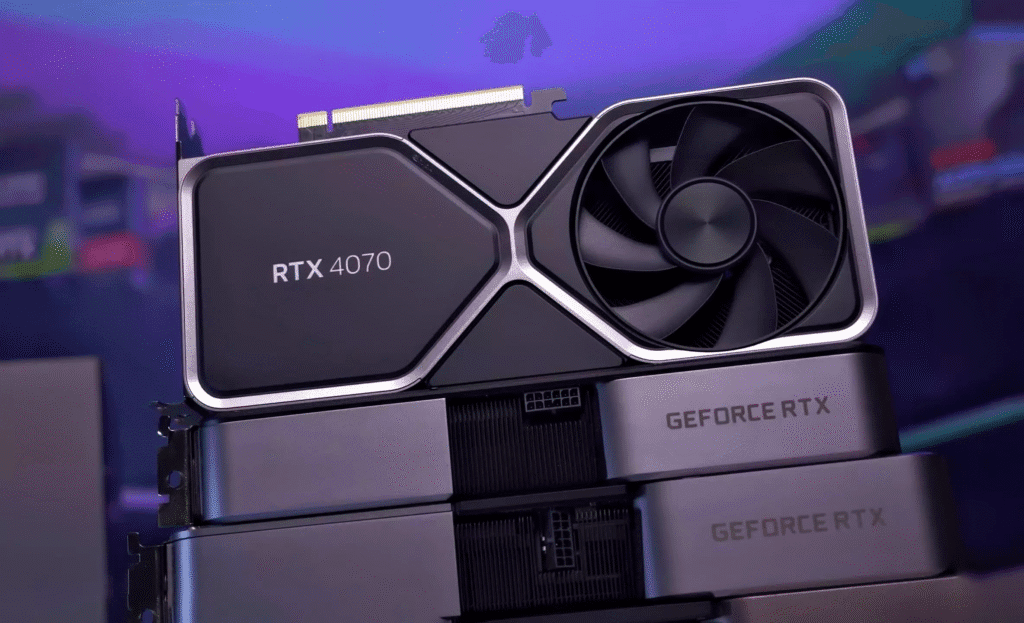
RTX 4070: newer, leaner, and a lot easier to justify than some older power-hungry cards.
As of March 2026, a fair used RTX 4070 price in Europe sits around €420–€550, depending on model, proof of testing, seller type, and marketplace. The reason buyers still care is simple: NVIDIA launched the RTX 4070 at $599 with 12GB GDDR6X and a 200W Total Graphics Power, and reviewers broadly placed it around RTX 3080-class 1440p performance with much better efficiency.
Verdict Box
- Fair used price (EU): €420–€550
- Buy if:
- You want a strong 1440p card with 12GB VRAM and much lower power draw than older Ampere options.
- The seller provides GPU-Z / HWiNFO proof and a quick stress-test result.
- The card lands near the low-to-mid €400s, not the top of the current used band.
Skip if:
- The price drifts too close to newer cards or cleaner used alternatives. Current 50-series pricing in Europe means overlap can happen.
- The seller cannot prove stability, ownership history, or basic sensor behavior.
- You are paying almost €550 for a bare card with weak proof and no real buyer protection.
Best alternative: a clean used RTX 3080 if it is materially cheaper and you accept higher power draw and older-platform risk.
Last checked: March 2026
Fair used price in Europe (2026)
The clearest Europe-wide takeaway is that the used RTX 4070 currently lives in a €420–€550 band, with the best value usually in the lower half. In Germany, current eBay.de listings show examples around €420, €429, €440, €449, €460, and €470 for used RTX 4070 cards, which gives a strong real-world anchor for buyers who want to avoid guessing. Kleinanzeigen results skew higher in the visible snippets, often around €600 asking prices, which is a good reminder that not every marketplace ask is a fair one.
Italy is broader and a bit noisier, but still useful. Subito currently shows used RTX 4070 examples around €440, €480, €499, €500, €520, and €550, with some 4070 Super listings mixed into the search as well. France is harder to pin down cleanly from leboncoin snippets alone, so I would treat it as Not confirmed for a precise card-only band here. The buyer move is still obvious: use eBay.de, Kleinanzeigen, leboncoin, and Subito as live checks before you message a seller. Do this now: benchmark the listing against at least two Germany/Italy marketplace anchors before making an offer.
What affects used pricing
The RTX 4070 holds value because it solves a real buyer problem. It offers 12GB GDDR6X, modern NVIDIA features like DLSS 3, and performance reviewers described as roughly in the RTX 3080 neighborhood while using much less power. That combination matters in Europe, where electricity costs and case thermals are not abstract forum talking points. In plain English: it feels like a newer, cleaner ownership experience than many older high-end Ampere cards, so sellers can still ask decent money for it.
The second price driver is risk control. A used RTX 4070 is not rare, so buyers should pay more only when the listing earns it with proof, condition, and protection. EU rules also matter here: second-hand goods bought from a professional seller are still covered by the minimum legal guarantee, though in some countries that can be reduced to one year by agreement. That makes a boring, documented listing more valuable than a slightly cheaper “works perfectly” card with nothing behind it.
- Condition: dust, bent fins, rough fan noise, and scratches around screws can hint at hard use or previous disassembly.
- Brand / cooler: premium coolers and quieter triple-fan models can hold a price premium over basic dual-fan cards. Current eBay.de listings already show that spread.
- Warranty / seller protection: pro-seller listings deserve a modest premium because buyer recourse is stronger.
- VRAM / model positioning: the RTX 4070’s 12GB helps its used value more than another 8GB midrange card would.
- Marketplace risk: private deals can still be good, but the discount should be meaningful if testing or returns are weak.
Avoid this: paying top-of-band money for a card that comes with vague wording, no test proof, and no protection.
Is it worth it in 2026?
Yes — the RTX 4070 is one of the easier used GPUs to justify in 2026. NVIDIA launched it as a 1440p-focused card, and review coverage consistently framed it as a highly efficient option with performance around the RTX 3080 class. That means it still makes sense for buyers who want strong 1440p gaming, NVIDIA features, and lower hassle than older, hotter Ampere cards. It is not cheap enough to be an impulse buy, but it is modern enough that the ownership experience usually makes sense if the used price is right.
Where it gets shaky is at the top end of the used band. If a seller wants €540–€550 with weak proof, you are no longer buying “value”; you are paying a convenience premium. There is also a market-context wrinkle now: newer 50-series cards have seen European price movement, which can squeeze the used value story if the gap closes too much. So the RTX 4070 is worth it in 2026, but mainly when it still behaves like a discounted premium 1440p card rather than a near-new one.
Who this is for
- Buyers who want a strong 1440p card with 12GB VRAM and better efficiency than older Ampere options.
- Users who care about NVIDIA features like DLSS 3 and a lower-power build.
- People willing to test or verify a used card properly before paying.
Who this is not for
- Buyers chasing the absolute cheapest euro-per-frame at any risk level.
- People who mainly want a bargain 1080p card; the RTX 4070 is usually overkill for that budget lane.
- Anyone paying near-top used prices without comparing against current new-card crossover points.
Quick decision: buy the RTX 4070 in 2026 when it lands in the €420–€480 zone with clean proof; think much harder once it drifts toward €550.
Best alternatives
The closest used alternative is usually the RTX 3080. Review coverage at launch repeatedly framed the RTX 4070 as delivering roughly RTX 3080-level gaming while consuming far less power, which is exactly why the comparison still matters in 2026. If a used 3080 is meaningfully cheaper, it can still be good value. But if the prices are close, the 4070’s newer architecture, lower 200W power target, and 12GB memory make it the cleaner long-term buy for most people.
The second alternative is to wait for price crossover with newer cards instead of forcing a used deal that is not actually a deal. That is especially true if a near-€550 used 4070 starts looking too close to newer stock in your country. This page is price-first for a reason: the RTX 4070 is not the best card in a vacuum, but it is a very strong buy when it sits clearly below new-card territory and clearly above riskier old-flagship compromises.
| GPU | Typical used price (EU) | VRAM | Best for | Trade-offs |
|---|---|---|---|---|
| RTX 4070 | €420–€550 | 12GB | 1440p gaming, lower-power premium used build | Can get overpriced near the top of the band |
| RTX 3080 | Not confirmed here | 10GB / 12GB | Cheaper raw-performance alternative | Higher power, older card, hotter ownership |
| RTX 3090 | Not confirmed here | 24GB | VRAM-heavy creator / AI use | More power, more heat, often pricier |
| RTX 4070 Super | Not confirmed here | 12GB | Faster newer step-up | Usually costs enough more to weaken the used-value story |
The table is deliberately conservative: only the RTX 4070 row uses a current Europe band researched here; the others are directional comparisons and should be checked live before publishing exact price figures.
Best pick for most people: the RTX 4070 is the safer all-rounder when it is comfortably below the price of cleaner newer alternatives and not too close to them.
People also liked
A few solid next reads if you’re comparing value, checking alternatives, or trying not to buy a GPU with a mysterious past.
Deal Score (0–10)
A good RTX 4070 deal is not just a low number. It is a mix of price vs current local range, seller trust, condition, and whether the seller can show proof that the card behaves normally under load. Because the used 4070 market is active, you usually do not need to panic-buy the first decent listing you see. That is exactly why the deal score matters more here than for rarer cards: you have enough supply to reject weak evidence.
The smartest buyer mindset is simple: pay for certainty, not just silicon. If a professional seller offers a fair price, clean photos, proof of testing, and clearer recourse, that can beat a slightly cheaper private sale. Under EU rules, second-hand goods from professional sellers still carry a legal guarantee, though in some countries the period can be shortened to at least one year if stated clearly. That does not make every pro listing good, but it does change the risk math.
3 simple scoring rules
- 8–10/10: around €420–€480, clear proof of testing, good seller history, and some return path or legal protection.
- 5–7/10: around €490–€520, average proof, nothing obviously wrong, but not a standout deal.
- 0–4/10: near €540–€550+, weak proof, unclear history, or “works fine” copy doing all the heavy lifting.
Used Risk (read before you buy)
The RTX 4070 is newer and easier to live with than many Ampere cards, but it is still a GDDR6X-era used GPU, so thermal behavior matters. I would watch GPU temperature, hotspot behavior where available, fan response, and any hint the card has already been opened for pads or paste. HWiNFO exists specifically to monitor real-time sensor data, and OCCT is built to stress GPU, memory, and VRAM stability. On a used card in this price band, guessing is lazy.
Ex-mining risk is lower for a 4070 than for much older boom-era cards, but it is still not something I would dismiss if the listing is vague. Fan wear, pad wear, and previous disassembly can all matter more than a nice front photo. This is also why GPU-Z or HWiNFO proof matters: you want to see that the card identifies correctly, behaves normally, and does not immediately look suspicious before you even think about paying a premium used price.
How to check in 5 minutes
- Open GPU-Z or request a screenshot to confirm the exact GPU and basic sensor behavior.
- Open HWiNFO and watch temperatures, clocks, and fan speed under a short load.
- Run OCCT with a short GPU and VRAM stability test.
- Listen for ugly fan noise and check for crashes, artifacts, or weird clock drops.
- Ask whether the card was opened, repadded, mined on, or sold with any receipt or serial proof.
Safe-buy checklist
A safe RTX 4070 buy starts with market context. Check eBay.de, Kleinanzeigen, and at least one other EU marketplace first, then score the specific listing against those anchors. This card is too common to justify panic-buying. If one seller is vague and another is transparent, the transparent one is usually the better deal even at a slightly higher number, because your downside is smaller.
Then do the boring verification work. Ask for GPU-Z, ask for HWiNFO sensors, ask for a quick stress test. If the seller dodges all of that while asking premium money, they are telling you something already. The RTX 4070’s whole value story in 2026 is that it offers a modern-feeling ownership experience at a used discount. Protect that by refusing listings that make the risk feel old-fashioned.
DO THIS
- Compare prices across eBay.de, Kleinanzeigen, leboncoin, and Subito first.
- Ask for GPU-Z proof of the exact card.
- Ask for HWiNFO sensor screenshots under load.
- Run or request a short OCCT GPU + VRAM test.
- Prefer sellers with receipts, clear history, or legal buyer protection.
AVOID THIS
- Listings with premium prices and zero proof.
- Paying top-band money because the card “looks clean.”
- Ignoring thermal or fan behavior because average FPS sounds good.
- Assuming every professional seller is automatically good value.
- Treating a private sale with no recourse like it deserves a retail-like price
FAQ
What is a fair used RTX 4070 price in Europe in 2026?
A fair current asking-price range is roughly €420–€550, with the stronger value usually in the lower half of that band.
Why does the RTX 4070 still hold value?
Because it pairs 12GB GDDR6X with strong 1440p performance and much better efficiency than older Ampere alternatives.
Is the RTX 4070 still good for gaming in 2026?
Yes, especially for 1440p. Launch reviews and current hierarchy coverage still place it in a strong performance tier for that target.
Is the RTX 4070 better value than the RTX 3080?
Often yes if the prices are close, because the 4070 is newer, far more efficient, and easier to own long term. If the 3080 is much cheaper, the answer gets closer.
What should I check before buying a used RTX 4070?
Confirm the card with GPU-Z, inspect sensors in HWiNFO, and run a short OCCT GPU + VRAM test.
Does the RTX 4070 have an AI Tax?
Not a major one. Its 12GB helps resale, but it does not get the same used-price distortion as 16GB–24GB cards aimed harder at local AI or heavy creator use.
Should I buy from a private seller or a professional seller?
A professional seller can be safer because EU second-hand goods from pros still carry a legal guarantee, though country rules can reduce the period to at least one year if disclosed.
Is €550 too much for a used RTX 4070?
Usually it is the high end of the current range, so it needs excellent proof, condition, and protection to feel justified.
Is the RTX 4070 good for 4K?
It can do some 4K with help from features like DLSS, but review coverage consistently framed it as a stronger 1440p buy than a pure 4K one.
The used RTX 4070 is one of the cleaner EU buys in 2026 because the case for it is simple: 12GB VRAM, strong 1440p performance, much better efficiency than older Ampere cards, and a current used band that can still make sense. The mistake is paying near-new money just because the card has a good reputation. What’s next? Compare today’s listing against Germany and Italy price anchors, then buy only if the proof matches the price.